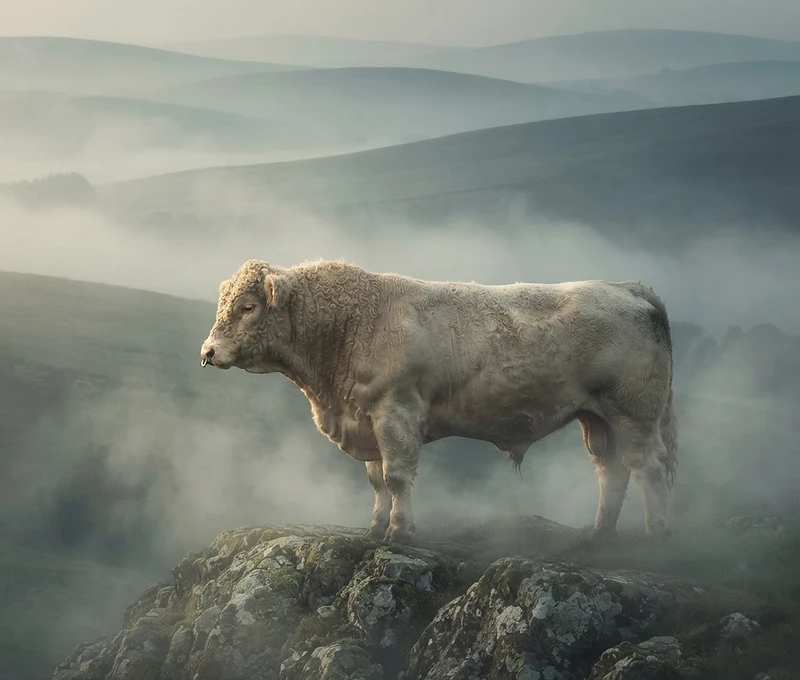
The WhitebredShorthorn
Known originally as the Cumberland White, the Whitebred Shorthorn is a distinct, always-white branch of the Shorthorn family — never specialised for beef or dairy, and so kept as the hardy, thrifty upland type that sires the celebrated Blue Grey. Today it is among the rarest native cattle in Britain, listed At Risk by the Rare Breeds Survival Trust.
Where the mist lays hold of the hill and the hill of the cow, a white coat keeps the weather — then, as now.
Anatomical
precision,
archived.
Every standard, measured. Unlike its specialised Beef and Dairy cousins, the Whitebred Shorthorn was never split for the showyard or the dairy — it remains the traditional, thrifty upland type, refined across two centuries of border breeding for hardiness, quiet temperament, and unrivalled crossing merit with the black Galloway cow and the Aberdeen Angus to create exceptional hybrid vigour.
Two hundred years of patience, written in bone — the thrift of the upland, made flesh and known.
Coat & Constitution
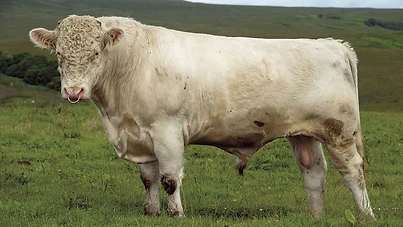
01The breed's defining creamy-white outer coat sits over a thick, mossy undercoat —a double layer that insulates against driving border weather and lets the cattle outwinter on poor upland forage without supplementary feed. The white coat is a required breed characteristic, and the pigmented skin beneath helps protect against sun and flies in exposed upland conditions; the undercoat sheds in spring to a lighter summer coat that still turns the rain. The coat's natural oiliness helps shed the relentless border rain, and the breed's thrift means cows can hold condition on forage that would barely sustain a continental animal. The same thrift makes them outstanding conservation grazers, cropping rank grasses to keep hill pastures open and botanically diverse.
Temperament
02Docile, intelligent and easily handled, the Whitebred is prized by upland farmers for its quietness —a temperament that suits extensive, low-input systems and makes the breed safe around stock and children. The breed's intelligence and willingness make it responsive to quiet, low-stress handling, and bulls are notably amenable — a critical trait where a bull runs with the herd on open hill for months. Cows are fertile, long-lived and strongly maternal, calving easily and rarely needing assistance even on the open hill; as a crossing sire the breed passes on easily-calved, milky, maternal and lightweight calves. This ease of handling, combined with low feed costs, is precisely why the breed endures on marginal land where more intensive cattle would be uneconomic.
Frame & Conformation
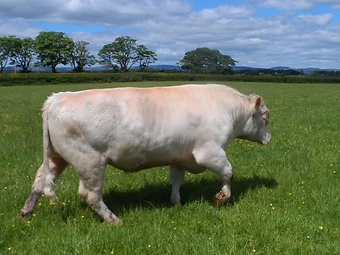
03A medium-sized, clean-boned animal with a broad muzzle, alert bright eyes and sound legs and feet built for rough grazing —cows weigh 550–600 kg and bulls 800–900 kg. The head is characteristically clean, the topline level and the hindquarters well-fleshed for a thrifty upland type; the breed standard calls for a straight back, wide level hindquarters and a deep rounded body, with fine bone and a soft mellow skin indicating dairy-derived thrift rather than coarseness. Sound feet and a free, ground-covering stride are essential for cattle that must walk miles of hill to graze, and the frame is balanced and true to type, never coarsened for the showyard. The breed's moderate size is itself an advantage on the hills — smaller mouths graze closer, lighter frames tread softer on wet ground, and less bodyweight means less feed burned against the cold.
Crossing Potential
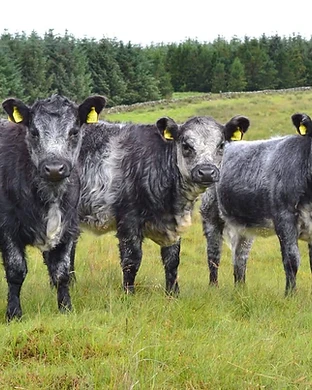
04The breed's enduring purpose: siring the Blue Grey, a blue-roan calf from the black Galloway or Aberdeen Angus cow that combines Whitebred hardiness with Galloway/Aberdeen Angus meat quality and converts rough pasture into high-grade beef. The Blue Grey's/Blue Roan's reputation for turning poor keep into quality beef made it a mainstay of the northern suckled-calf sales for over a century, and the cross remains the economic engine that keeps the purebred Whitebred relevant today. The Blue Grey/Blue Roan is prized for its early maturity and fine marbling, finishing on rough grazing where continental breeds would fail, and the Whitebred is also crossed with the Beef Shorthorn, the Aberdeen Angus and other native cows for hardy, thrifty stores. The colour does not breed true, so every Blue Grey/Blue Roan is made fresh each generation.
Suckler Replacements
05If your primary goal is breeding top-tier suckler replacements, using a Whitebred Shorthorn bull over Aberdeen Angus or Galloway cows is an outstanding strategy. This specific cross produces a highly efficient, medium-sized, long-lived suckler cow that thrives in low-input systems. Because both parent lines are traditional British native breeds, the female offspring exhibit powerful maternal heterosis (hybrid vigour).
Why this cross makes an ideal suckler cow:
Exceptional Milk & Pelvic Area —The Whitebred Shorthorn is renowned for passing on superb milk yields and a wide pelvic structure. Crossed with the Angus, you get a replacement female that calves easily on her own and has more than enough high-quality milk to rear a heavy, fast-growing calf.
The Easy-Keep Advantage —Both breeds are highly efficient converters of forage. The resulting cows maintain body condition score incredibly well on cheap grass-and-silage diets without expensive concentrates.
Docility & Longevity —This female line is exceptionally quiet and low-stress to handle at calving, with sound feet and legs for a long, productive working life.
Compact Cow Size —Keeping mature weight around 600–650kg means lower maintenance costs per cow, letting you carry more stock on the same acreage than heavy continental-cross dams.
The Next Step —Once you have these high-performing Whitebred Shorthorn cross females (like Blue Greys), they are then ideal to run back to a true terminal sire such as a Charolais or Simmental to produce fast-growing, high-grade prime beef calves.

Coat & Constitution selected.
The calving solution
you've been
looking for.
Every cattle producer knows that managing first-time heifers is one of the most high-stakes periods on the farm. Dystocia — calving difficulty — can devastate your herd's productivity, leading to high veterinary costs, lost calves, and damaged heifers. Fortunately, nature and strategic breeding provide an exceptional solution: the Whitebred Shorthorn bull.

Renowned for decades as the premier choice for maternal crossing, the Whitebred Shorthorn is genetically predisposed to throw calves with exceptionally light birth weights and fine, streamlined bone structures. When modern commercial beef producers cross a Whitebred Shorthorn bull with young Galloway heifers and Angus heifers, the biological synergy is unmatched:
Sleek Calf Profiles
The fine-boned genetics ensure the calf is shaped to slide out naturally and easily, dramatically reducing maternal-fetal disproportion.
Drastically Lowered Dystocia Risk
By keeping birth weights modest, you protect your young heifers from pelvic trauma, ensuring a rapid recovery and a faster return to the breeding cycle.
The Legendary Blue-Grey or Blue-Roan Advantage
This cross doesn't just protect your heifers — it produces highly marketable, exceptionally hardy, and vigorous hybrid calves that command top value in the marketplace.
Protect your investment,
secure your profits.
Don't let calving difficulties compromise the future of your replacement heifers. By introducing a Whitebred Shorthorn sire to your Angus herd, you are investing in peace of mind during calving season, superior animal welfare, and elite hybrid vigour.
Light calf, easy cow — the old hill rhyme; a quiet sire, a kindled spring, in time.
Choose the time-tested, genetically proven path to seamless calving.
Choose Whitebred Shorthorn →A rare breed,
suddenly right
for our times.
The Whitebred Shorthorn was shaped by scarcity — by poor keep, long winters, and the cold economics of the border hills. The same thrift that kept it alive for two hundred years is precisely what a warming, cost-conscious, biodiversity-hungry world is learning to value again.
Shaped by the scarce, kept by the few — what the hills taught, the market knew.
Low-input by nature
01Two centuries of border hill farming shaped a cow that holds her condition on rough forage alone — no bought-in concentrates, no grain. In an age of climbing feed and fertiliser costs, that thrift reads straight onto the bottom line.
Regenerative on the hills
02Light feet and a selective bite keep rank grasses down and let the wildflowers up. The breed is already at work conservation-grazing the very uplands it was raised on — turning marginal land into living, biodiverse pasture.
Genetics the industry lost
03Decades of continental selection traded away the native maternal hardiness, longevity and easy calving that the Whitebred never lost. Those quiet, unfashionable traits are — suddenly, commercially — valuable again.
A living heritage
04Listed At Risk, the Whitebred is among the rarest native cattle in Britain. To keep a breeding cow is an act of stewardship — and, through the celebrated Blue Grey, still a paying one. Rare, and relevant, are no longer at odds.
“What the hills taught this breed, the market is remembering — that the thrifty, the hardy and the rare were never out of step. They were simply ahead.”
The Whitebred Shorthorn — kept, because it countsA living record of the
Whitebred.
Gathered from breeders, breed societies and conservation archives across Britain — a visual record of the cattle, the country they belong to, and the people who keep them. Click any frame to view at scale.
Imagery courtesy of the Rare Breeds Survival Trust, the Whitebred Shorthorn Association, Geograph Britain & Ireland & Wikimedia Commons